What we say

When Sumantha called to suggest a daytime arrival, I should have listened. But we arrived at night: a 1.8km trek through the buffer zone, four river crossings on stepping stones, a wooden raft and a log bridge and fresh leopard prints. Not ideal but exciting. Then morning came. Blue skies over the Shivaliks, the river forming the boundary, an orchestra of birds. I was hooked.

Vanghat: “van” (jungle) and “ghat” (valley). One of the most remote wildlife lodges in northern India, created in 2006 to keep this valley protected. What makes it special are the walking safaris in tiger country which barely exist in India. Each trek here, with trained naturalists reveals things a jeep never could: discussions about medicinal plants, picking up on alarm calls, birdsong you learn to identify, a pace that lets the forest come to you.

Add to this, stone and mud cottages, charpois on wraparound balconies, no WiFi, no phone signal. Evenings are candlelit, chat enhanced around a campfire, and you fall asleep to the gurgling river. Sumantha was right about arriving in daylight. He was right about everything else.

Our three words:

Remote | Off Grid | Extraordinary

Philippa…

Hotel Story

Vanghat Lodge is one of northern India’s most remote wildlife retreats, set on the Western Ramganga River banks deep inside Corbett Tiger Reserve, accessible only by forest walk or raft crossing.⁠

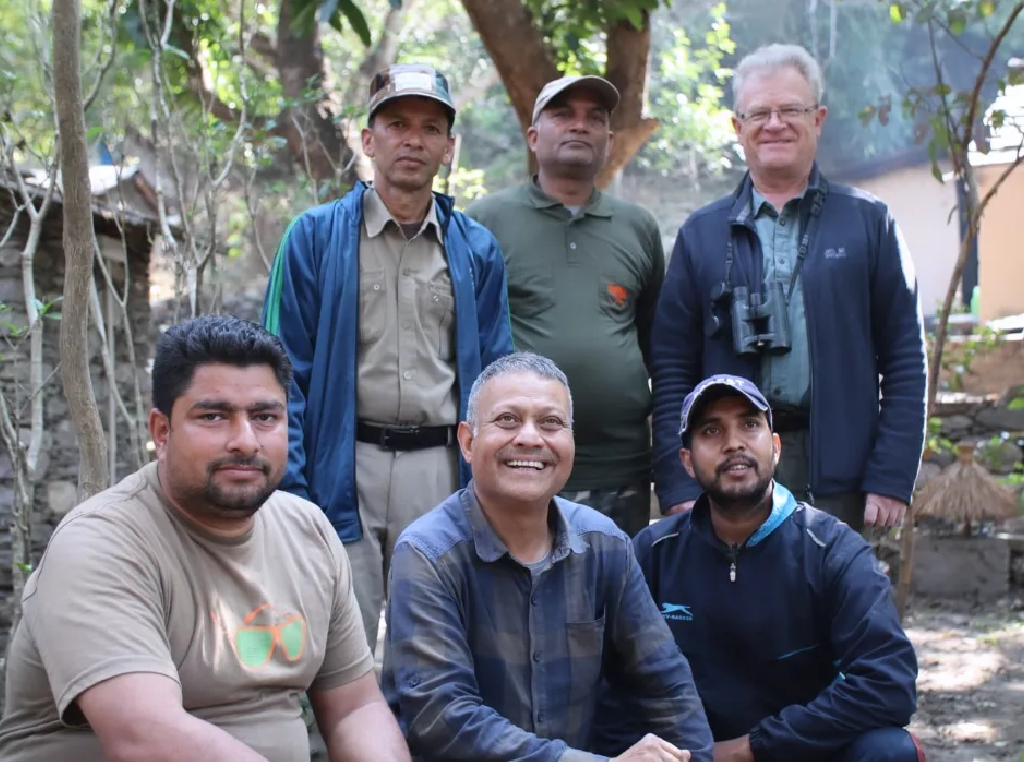
Sumantha Ghosh came upon this abandoned village site on the Ramganga in 1999 while chief naturalist at Tiger Tops. The land was degraded, the river fished with explosives. He set up a revenue-sharing scheme that turned poachers into protectors, and within a year the Ramganga boasted some of the finest Mahseer beats anywhere. Disconcerted with popular tiger tourism, he built mud and thatch bungalows for genuine wildlife enthusiasts. 92% local staff run the lodge today.

The philosophy centres on low-impact, conservation-focused immersive wilderness experiences that prioritize environmental stewardship and authentic forest encounters. This approach ensures minimal disturbance to wildlife habitats while maximizing educational value for guests seeking genuine wilderness connections.⁠

Built using predominantly local materials including clay, stone, and bamboo, the property features eight unique accommodations comprising four mud cottages, two forest rest houses, and two trapper huts that blend seamlessly with the natural environment. Complete elimination of single-use plastics, comprehensive wastewater recycling, and locally sourced organic food demonstrate exceptional environmental commitment. The lodge operates with predominantly local staff while supporting community projects including Mahseer fish conservation, rewilding initiatives, and village-based programmes promoting local produce and handicrafts.⁠

Life at Vanghat embraces simplicity through guided forest walks, birding expeditions, riverside hikes, and quiet wildlife observation. Locally sourced meals reflect regional Kumaoni culture alongside contemporary cuisine prepared in homely style. The remote riverside setting, reached via 4×4 drive and raft crossing followed by forest walking, offers camera trapping experiences, diverse birding opportunities, and village interactions that create profound wilderness connections within pristine tiger reserve habitat.⁠

SUSTAINABLE SCORE : 65/70

  • Land Reclamation/Rewilding 10
  • Food from 50 Mile Radius 10
  • Organic Produce 8
  • Wastewater Recycling  8
  • Natural Materials / Heritage Building 9
  • Single Plastic Use Never 10   
  • Local Staff 9

SUSTAINABLE INITIATIVES

  • Mahseer conservation
  • community-based programme in Jamaria Village
  • support for Harela (a tiger–women conflict village) now promoting local produce and handicrafts.
  • mineral-rich natural spring water (filtered and completely safe) is used for drinking. 
  • Striving towards obtaining as much electricity from solar panels.
  •  outdoor lighting limited to candles and a camp fire

SUSTAINABLE SCORE : 65/70

  • Land Reclamation/Rewilding 10
  • Food from 50 Mile Radius 10
  • Organic Produce 8
  • Wastewater Recycling  8
  • Natural Materials / Heritage Building 9
  • Single Plastic Use Never 10   
  • Local Staff 9

SUSTAINABLE INITIATIVES

  • Mahseer conservation
  • community-based programme in Jamaria Village
  • support for Harela (a tiger–women conflict village) now promoting local produce and handicrafts.
  • mineral-rich natural spring water (filtered and completely safe) is used for drinking. 
  • Striving towards obtaining as much electricity from solar panels.
  •  outdoor lighting limited to candles and a camp fire

EXPERIENCES

HOW TO REACH HERE

Vanghat is reached from Marchula village by a short 4×4 drive and a raft across the Ramganga River, followed by a 1.8 km walk through the forest.

BY AIR: Delhi International 310km (6.5 hours)

BY RAIL:Ramnagar 35 km (1 hour)